GEOG 1700: Natural Disasters (PS)
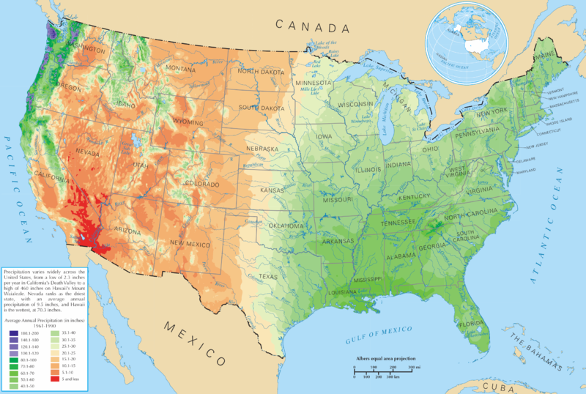
Image Source:http://www.nationalatlas.gov/printable/precipitation.html FromWikipedia Commons.
Chosen Issue : Climate change is causing global precipitation patterns to change. This in turn is causing massive flooding and droughts.
Main Cause of Climate Change: Most of us can say in the summer months that the heat has been more intense over the past years and our rain or snow fall has decreased. When temperature rises and the air in the atmosphere become warmer the moisture that is in the air that causes rain or snow storms evaporates. You might ask; why can’t this heat escape the earth? The answer to that question is that there are certain gases in the atmosphere that hinder the heat from escaping.
These are the gases that impact climate change:
Water Vapor - Increases as earth’s atmosphere warms
Carbon Dioxide – Released through natural processes such as respiration and volcanic eruptions as well as human activities that include: deforestation, land use changes, and the burning of fossil fuels.
Methane – Hydrocarbon gas produced through natural sources and human activities such as: decomposition of waste in landfills, agriculture, ruminant and manure management.
Nitrous Oxide – Produced by soil cultivation, fossil fuel combustion, nitric acid, and biomass burning.
Some of these causes of the gasses in the atmosphere are natural while some of them are caused by us humans; yes, the blame is on you!
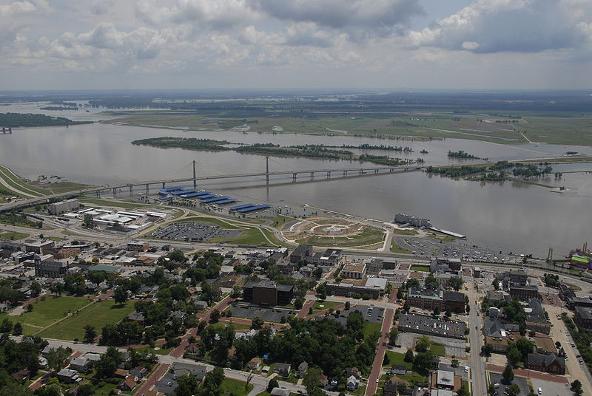
Image Source: Located in Illinois by: Master Sgt. Ken Stephens From Wikipedia Commons.
Where this occurs: The easy way to answer this is to say this climate change occurs all over the world. The main problem that comes from climate change is flooding. Water is one of the most important element we as humans need, second to oxygen. With water we use it for drinking and nourishment as well as growing food with irrigation systems, and even as a way of transportation. Places of risk include coastal cities, heavily populated cities this includes many Asian countries and heavy developed area that are in the United States, Japan and the Netherlands. Other high risk areas also are places that receive more perspiration than normal, low-lying areas and poor communities because they will have a harder time adapting to the increased flooding.
The OECD (Organization for economic Co-Operation and Development), an international organization with 30 supporting countries (which includes the U.S.) have released a report listing 10 cities that face the highest risk of flooding these cities are: Mumbai, Guangzhou, Shanghai, Miami, Ho Chi Minh, Calcutta, New York City (we saw this with Hurricane Sandy), Alexandria and New Orleans (Hurricane Katrina). This organization predicts that by 2080, millions more people will experience flooding every year because of rising sea levels. If global Temperature rise approx. one degree in the next one hundred years the sea level could rise seven to fifteen inches.
Why this Occurs: This climate change occurs mainly because of human activity. Climates will change if the factors that influence them fluctuate. To change climate on a global scale, either the amount of heat that is let into the system changes, or the amount of heat that is let out of the system changes. When there is warmer weather this is because more heat is let into the earth’s atmosphere and colder weather there is less heat in the earth’s atmosphere, easy enough right?
We ask ourselves, where does this heat come from? We need to think big picture, the Sun. The Sun is what is let into the earth’s atmosphere and heats the land surfaces as well as the earth’s oceans. But on the other hand that amount is always changing, this causes climate change. The earth’s Orbit is also to blame this affects the amount of solar energy that reaches the Earth.
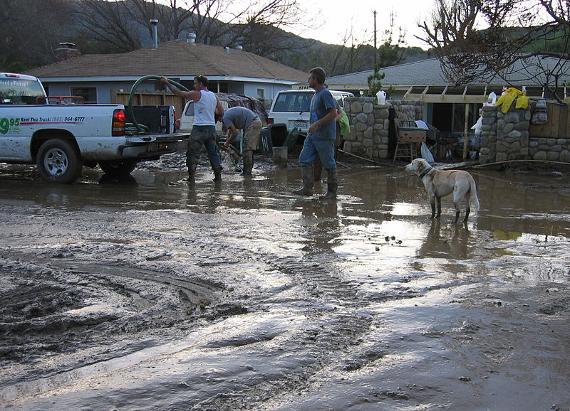
Image Source: Located in Casitas Springs, CA by: John Shea From Wikipedia Commons.
What is to be done?: There is not just one thing we can do. The question I pose ais this; is it too late? Are we just delaying the inevitable? Maybe so but if we are going to die someday why not stall it right? We as a whole should do these simple things to help climate change that can cause flooding or even a drought.
- Carpool, this is obvious this makes fewer carbons that go into the air because of less traffic. You could also start using public transportation or even ride a bike. Hybrid cars could even come in handy.
- Recycle, this makes us dig less for natural resources that make plastics and other material that is hard to decompose that end up in our landfills.
- Use less electricity; you can even buy the energy efficient light bulbs that cut down the electricity you use by 25%.
This shouldn’t be an individual chore. Please have those who you care about and love, heck tell those who you don’t like to think wiser about the decisions they are making that could be harmful to the earth. Try to think of other ways you could be more efficient at home, in the office and your local school. Let’s be a team and go green!
 Clipart From Wikipedia Commons. |
This Is My Reflection:
I learned that procrastination will always get you. I should have been better about the research that was provided in this assignment. This was an assignment that should have taken a couple of weeks to prepare and look at. All in all this assignment helped me realize what things I am able to do to help us from having drastic climate change. I used to be an electrician and know some of those tricks to be able to cut down.
My mother in-law is always on my case about recycling and I always get so bugged about it. I now know the importance and will work on what I need to do to be better. I also was reminded how important clean water is to everyone and how much I take it for granted. I also learned the science behind climate change such as the greenhouse effect and all the gasses that cause climate change and what produces those gasses.
Sources Used:
- (2013, Jan. 14). Retrieved from NationalAtlas.Gov: http://www.nationalatlas.gov/printable/precipitation.html#list
- National Center of Atmospheric Resarch. (2013, Feb 24). Retrieved from http://www.eo.ucar.edu/basics/cc_1_a.html
- NPA. (2012, Sept. 27). Retrieved from http://www.epa.gov/climatechange/ghgemissions/
- Tenenbaum, L. F. (n.d.). Retrieved Feb. 23, 2013, from NASA.GOV: http://climate.nasa.gov/causes/
- Vigran, A. (Jan, 14 2008). NPR. Retrieved Feb. 23, 2013, from http://www.npr.org/templates/story/story.php?storyId=18022014
